
David Sacks Predicts the End of “Banks vs Crypto”
David Sacks, often referred to as the White House “crypto czar,” says the long-standing divide between traditional banks and crypto is coming to an end.
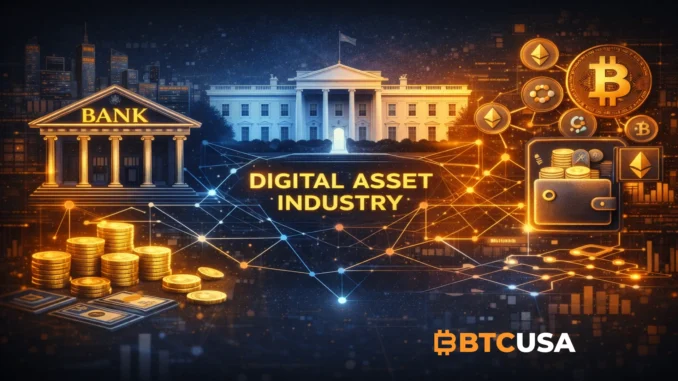
In a recent interview, Sacks stated that cryptocurrencies, stablecoins, and banks will ultimately merge into a single digital asset industry. According to him, once comprehensive crypto market structure legislation is passed, banks will enter the crypto space at scale, erasing the boundary between traditional finance and blockchain-based systems.
Stablecoins and the Core Regulatory Dispute
One of the main sticking points in current US crypto legislation is whether stablecoin issuers should be allowed to pay yield to holders.
Sacks explained that opposition from banks centers on this exact issue. However, he noted that some form of yield is already embedded in the GENIUS Act, meaning the mechanism will likely exist regardless of resistance.
According to Sacks, if banks fail to reach a compromise now, they risk losing anyway as yield-bearing stablecoins emerge under existing laws. His view is that a “good compromise” is one where no party is fully satisfied, but a comprehensive market structure law is ultimately more important than any single provision.
Banks Will Eventually Embrace Stablecoin Yield
Sacks believes banks will initially resist yield-bearing stablecoins, but that stance will change once they become active participants in the stablecoin business themselves.
Over time, banks are expected to see yield not as a threat, but as a competitive advantage within a unified digital asset framework. Once regulatory clarity is established, stablecoins could become a core product for both crypto-native firms and traditional financial institutions.
AI, Chips, and US–China Technology Competition
Beyond crypto, Sacks also addressed US–China competition in artificial intelligence and semiconductor technology.
He noted that China is increasingly focused on self-sufficiency, particularly through domestic champions like Huawei. Rather than relying on US chipmakers, China is building its own full-stack technology ecosystem.
The US strategy, according to Sacks, has been to allow China access to older-generation chips in order to slow Huawei’s expansion by capturing market share. However, he acknowledged that this approach may become less effective as China continues moving toward technological independence.
Comparing Trump and Biden on Tech Policy
Sacks offered a clear contrast between the regulatory environments under different administrations.
He argued that under Donald Trump, the technology sector experienced stronger support and less unnecessary regulation compared to the Biden administration. In his view, reduced regulatory pressure allowed innovation to move faster across both crypto and AI sectors.
Greenland and Long-Term US Strategic Interests
Sacks also commented on the recurring idea of the United States acquiring Greenland.
He emphasized that US interest in Greenland is not new and dates back roughly 150 years. According to Sacks, Trump simply brought the topic back into public discussion rather than introducing a novel geopolitical concept.
Why This Matters for Crypto Markets
The most significant takeaway from Sacks’ comments is the long-term direction of US crypto policy.
Rather than isolating crypto from traditional finance, regulators appear to be moving toward integration. Stablecoins, banks, and blockchain infrastructure are increasingly being treated as components of the same financial system.
If this vision materializes, crypto adoption could accelerate dramatically as regulatory uncertainty fades and institutional participation expands.
Final Thoughts
David Sacks’ comments suggest that the future of crypto regulation in the US is not about containment, but convergence.
As stablecoins gain clarity and banks enter the space, crypto may stop being viewed as an alternative system and instead become a foundational layer of modern finance.
BTCUSA Comment
The key signal here is not any single law or stablecoin provision, but the broader shift in mindset. When policymakers openly talk about a unified digital asset industry, it becomes clear that crypto is no longer treated as an outsider. If banks, stablecoins, and blockchain infrastructure converge under clear rules, the next phase of crypto adoption will likely be institutional, systemic, and far larger than anything seen so far.