Why mining is leaving data centers
For most of Bitcoin’s history, mining has been tied to industrial warehouses, noisy machines, and massive power consumption. This model made sense when efficiency meant building ever-larger facilities near cheap energy.
But in 2026, energy efficiency is no longer just about cheap electricity. It is about using waste heat. A large portion of the electricity consumed by ASICs is converted directly into heat. In data centers, this heat is treated as a problem. In homes, it can be an asset.
This is where the idea of household mining infrastructure begins.
Mining as a utility, not a side hustle
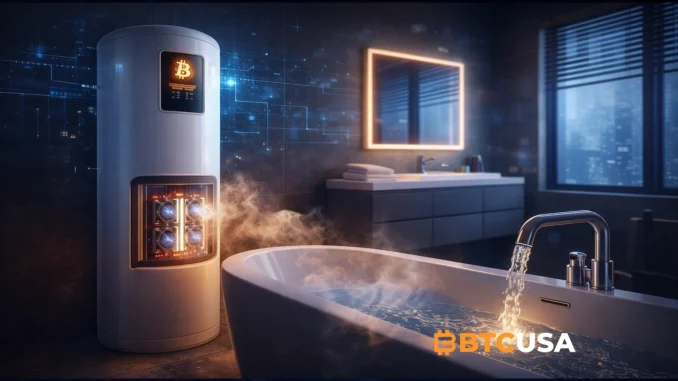
Superheat’s water heater concept flips the traditional mining narrative. Instead of burning energy only to secure the network, the device uses mining as a secondary function to heat water. You are no longer running a miner to earn Bitcoin. You are running a heater that happens to mine Bitcoin.
This changes how mining fits into daily life. The device replaces part of a household’s existing energy consumption rather than adding to it. That makes the economics fundamentally different from traditional mining setups.
The hidden efficiency of heat recycling
In a typical ASIC farm, almost all heat must be vented, cooled, or redirected at additional cost. In a water heater, that same heat becomes the primary output.
This model aligns incentives across three layers:
• households reduce net energy waste
• miners lower effective operating costs
• the network gains more geographically distributed hashpower
Over time, this could make Bitcoin’s energy footprint more politically defensible because electricity is no longer “wasted” purely for cryptographic security.
Toward distributed household compute networks
The most interesting part of Superheat’s roadmap is not just mining. It is the idea of linking thousands of household devices into a distributed compute network.
Instead of building new data centers, compute workloads could be spread across existing homes. Each device becomes a tiny node in a global network that provides heat, security, and potentially AI inference or other tasks.
This is not about replacing hyperscale cloud providers. It is about adding an entirely new layer of decentralized physical infrastructure.
Why this model could scale globally
Every household already consumes energy for heating water, air, and living spaces. Embedding compute into those systems does not require behavioral change. It only requires hardware upgrades.
Unlike traditional mining farms, this infrastructure can scale organically with housing stock. That gives Bitcoin something no other network has: a path to become embedded into everyday physical life.
BTCUSA outlook
Bitcoin mining is quietly shifting from isolated industrial zones into the fabric of daily living. Devices like mining water heaters are not gimmicks. They represent a new class of infrastructure where security, energy efficiency, and household utility converge.
If this model succeeds, Bitcoin will not just live in data centers. It will live inside the walls of people’s homes.