
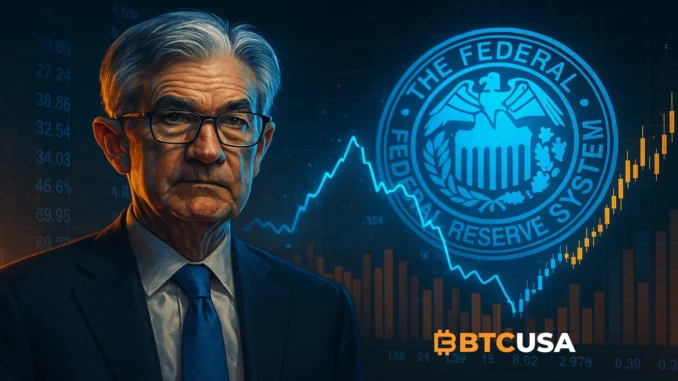
Fed Chair Jerome Powell highlights growing uncertainty ahead of key 2025 decisions
Federal Reserve Chair Jerome Powell provided a cautiously toned update on the state of US monetary policy, emphasizing that inflation remains too high, labor market risks are increasing, and incoming data remains distorted due to gaps in October and November reporting. His remarks suggest that the Fed is entering a phase of heightened uncertainty, requiring more granular data before adjusting rates.
Powell stressed that the central bank continues to rely heavily on fresh indicators, acknowledging that recent data sets may not fully reflect the true economic picture.
Inflation remains elevated, but further rate hikes are not the baseline scenario
Powell noted that every Fed president agrees inflation is still elevated and remains the top concern for policy decisions. However, he also made clear that raising rates again is not the baseline scenario for the Federal Reserve.
The internal debate now focuses on two paths: whether to hold rates at current levels for longer or to begin a gradual cutting cycle. Powell reiterated that the Fed has made meaningful progress in lowering inflation, but tariffs continue to drive goods inflation and could keep price pressures higher for longer.
Consumer spending remains resilient as AI-driven investment accelerates
Despite labor market weakness, consumer spending remains solid and continues to support overall economic growth. Powell highlighted that sustained investment in artificial intelligence data centers is now a major pillar of corporate spending, reinforcing a broader structural shift within the US economy.
The recent upward revision to GDP forecasts reflects both stable household demand and supportive fiscal policy, strengthening expectations for moderate economic expansion into 2025.
Labor market data shows signs of softening and potential overstatement
Powell confirmed that the labor market has weakened and faces additional downside risks. The Federal Reserve now believes that recent employment gains may have been overstated by 20,000 to 60,000 jobs per month. Unemployment may rise slightly—by only one or two tenths—but structural labor shortages and AI-driven reshuffling in certain industries could amplify risk.
Powell acknowledged that reduced labor force participation and changing workforce dynamics may complicate the Fed’s policy path throughout 2025.
Repo operations and reserve management remain central to policy stability
Powell reiterated that standing repo facilities are essential to keeping the federal funds rate within the target range. The Fed has reached sufficient reserve levels faster than expected, yet stability during the April 15 tax period remains a key policy objective.
To ensure ample liquidity, the Federal Reserve plans to continue purchasing US Treasuries in the coming months. Powell also emphasized that tariff-driven inflation must be evaluated carefully, as it may lead to one-time price increases that distort short-term readings.
Housing market remains under pressure despite easing expectations
Powell acknowledged significant challenges in the housing sector, noting that even a 25-basis-point cut may not noticeably improve affordability. Structural supply shortages, high mortgage rates and elevated prices continue to constrain the sector.
Diverging views inside the Fed, but broad support for the current stance
Although policymakers differ on whether to hold rates or begin cutting, Powell stressed that internal discussions remain thoughtful and respectful. The present policy stance received broad support across Federal Reserve leadership.
Incoming data over the next two months will shape whether the Fed leans toward an initial rate cut or maintains its wait-and-see approach.
Macro Insight: The Fed confronts a shifting economic landscape
Powell’s commentary reveals a Federal Reserve balancing structural shifts in the economy against ongoing inflationary forces. Consumer demand remains strong, and AI-driven investment continues to reinforce business activity, but labor dynamics are weakening in ways that may not yet appear fully in headline figures.
The Fed appears increasingly aware that inflation is becoming more supply-driven, particularly via tariffs, and not a result of overheated demand. This increases the likelihood of a cautious easing cycle, not to stimulate growth, but to recalibrate policy as structural forces reshape the US economy.
Market Analysis: Volatility likely as markets digest labor data and tariff pressures
Financial markets now face a wider distribution of outcomes for early 2025. With job data potentially overstated, and goods inflation influenced heavily by tariffs, traders remain uncertain about the timing and pace of rate cuts.
Risk assets—including equities and crypto—stand to benefit from any move toward earlier easing. However, tariff-driven inflation could delay aggressive cuts, keeping volatility elevated. Crypto markets in particular remain sensitive to liquidity cycles, and rate policy clarity may drive significant price movements over the next quarter.
The next wave of labor reports will be pivotal: confirmation of slowing job creation or rising layoffs would materially increase the probability of an earlier policy pivot.
BTCUSA Comment
Powell’s tone suggests a shift toward cautious optimism regarding inflation progress but heightened concern over labor market fragility. The Fed is clearly moving away from the threat of further hikes and toward evaluating the conditions for justified easing. Tariff-driven inflation complicates the story, but it does not fundamentally undermine the direction of long-term monetary policy.
This environment supports selective risk-taking but rewards patience. Markets may react sharply to every data print as the Fed’s path becomes more data-sensitive.
BTCUSA Outlook
Our outlook remains cautiously constructive. If upcoming reports confirm labor softening without a reacceleration in core inflation, the Fed may cut earlier than expected. This would provide a supportive backdrop for liquidity-sensitive assets, including Bitcoin and major altcoins.
However, persistent tariff inflation could delay any aggressive rate-cut cycle, meaning markets may oscillate between optimism and caution until clearer signals emerge. We expect March to June 2025 to be the decisive period for policy shifts.