

Table of Contents
TAO price prediction 2026–2030: how this forecast is built
This TAO price prediction is designed as a scenario system, not a single-number prophecy. In crypto, a single-point target is usually marketing. A useful TAO price prediction is a framework you can update as network data changes, liquidity conditions shift, and the market reprices AI infrastructure crypto.
This Bittensor price prediction model starts with the simplest truth: TAO is an altcoin, and altcoins are liquidity assets first. Even the best infrastructure tokens can underperform in risk-off regimes. That is why this TAO framework begins with market structure and only then adds Bittensor-specific variables like subnets, emissions, and TAO tokenomics.
What this TAO price prediction is:
- a year-by-year TAO price prediction for 2026, 2027, 2028, 2029, and TAO 2030
- a market cap logic engine that turns adoption assumptions into implied TAO prices
- a monitoring checklist that tells you what would confirm or invalidate the TAO framework
What this TAO price prediction is not:
- a promise
- financial advice
- a short-term trading signal
If you only read one section, read the market cap logic and the invalidation rules. That is where a TAO price prediction becomes useful instead of decorative.

Why TAO price prediction is different from most AI token forecasts
Many “AI token” forecasts are narrative-only. They treat “AI” like a magic multiplier and skip the hard part: how the token actually captures value. TAO price prediction requires more rigor because Bittensor is closer to an AI infrastructure protocol than a typical application token.
Bittensor attempts to create a decentralized market for machine intelligence where participants compete, are ranked, and are rewarded in TAO. In other words, Bittensor tries to price intelligence. That is why this Bittensor price prediction emphasizes demand pathways and incentive credibility.
The result: TAO price prediction should be built like an infrastructure model:
- supply dynamics and emissions matter
- participation incentives matter
- subnet growth matters
- category leadership in AI infrastructure crypto matters
A TAO framework that ignores these variables will usually overestimate upside in the wrong years and underestimate downside when liquidity tightens.
The core thesis behind this Bittensor price prediction
The thesis behind this TAO price prediction can be stated in one sentence:
If decentralized AI becomes a real crypto sector, and Bittensor remains the category leader, TAO can be priced like a scarce AI infrastructure asset with durable demand.
That sentence contains two conditions. A credible TAO price prediction must treat both as conditional.
Condition 1: decentralized AI becomes a meaningful category
This means capital, developers, and users treat decentralized AI as a structural layer, not a temporary theme.
Condition 2: Bittensor remains a leader
This means Bittensor subnets compound, incentives remain credible, and the market keeps assigning TAO an “AI infrastructure premium.”
If either condition breaks, this TAO framework compresses.
TAO tokenomics basics that matter for TAO price prediction
TAO tokenomics matters in TAO price prediction because emission structure shapes scarcity narratives, and scarcity narratives shape multiples during risk-on phases. But scarcity only matters if demand exists.
The tokenomics variables most relevant to this TAO price prediction are:
- long-horizon emission schedule
- market float expansion over time
- staking and participation effects on effective circulating supply
- perception of fairness and concentration risk in rewards
When markets are excited, they pay for clean, simple tokenomics. When markets are skeptical, they demand proof of real usage. This is why the same TAO tokenomics can support very different TAO outlook bands depending on the year.
Bittensor subnets: the adoption engine behind the TAO forecast
Subnets are the adoption engine that makes a Bittensor price prediction more than narrative. Each subnet is an incentive environment where participants compete and get rewarded. Subnets are why this TAO price prediction uses adoption tiers rather than a single growth curve.
In a strong scenario, subnets:
- attract builders
- retain participants
- produce outputs people actually want
- justify paying an AI infrastructure premium for TAO
In a weak scenario, subnets:
- multiply in count but not in quality
- get gamed
- fail to create durable demand pathways for TAO
That quality gap is why this TAO framework includes explicit invalidation rules later.
How to read TAO outlook bands
This TAO price prediction uses three bands per year:
- conservative band: liquidity is mixed, adoption is uncertain, multiples compress
- base-case band: constructive liquidity, visible subnet traction, moderate premium
- expansion band: risk-on rotation into AI infrastructure crypto, TAO treated as a flagship
These bands are intentionally wide. Crypto is a regime market, not a spreadsheet market.
Market structure that drives TAO price prediction
A TAO framework must respect market structure. Across cycles, the market often moves in this sequence:
- BTC leads and absorbs liquidity
- BTC consolidates, BTC dominance peaks
- capital rotates into higher beta sectors, including AI infrastructure crypto
- later, liquidity tightens and most alts compress
This means TAO price prediction is partly a timing model:
- TAO price prediction 2026 can be great in a strong rotation year, or disappointing in a choppy consolidation year
- TAO price prediction 2028 is a durability test where adoption matters more than hype
- TAO outlook 2029 can reprice early if markets front-run the next cycle
- TAO 2030 becomes increasingly about real sector share and structural demand
TAO price prediction 2026: first repricing window
TAO price prediction 2026 sits at the intersection of two forces: post-cycle psychology and the AI infrastructure narrative. In 2026, the market may still reward category leaders with premium multiples if risk appetite remains constructive.
TAO price prediction 2026 conservative band
$250–$450
Interpretation: mixed liquidity, AI narrative softens, multiples compress.
TAO price prediction 2026 base-case band
$450–$900
Interpretation: TAO maintains category leadership perception, subnets show ongoing traction.
TAO price prediction 2026 expansion band
$900–$1,600
Interpretation: strong risk-on rotation into AI infrastructure crypto, TAO treated as a flagship asset.
What pushes TAO outlook 2026 toward the expansion band:
- broad alt liquidity improves
- Bittensor subnet activity remains visibly strong
- market believes TAO tokenomics plus adoption creates a scarce AI infrastructure asset
What pushes TAO outlook 2026 toward the conservative band:
- macro tightening, liquidity risk-off
- market questions incentive integrity
- AI narrative rotation away from decentralized AI
TAO price prediction 2027: adoption begins to dominate
TAO price prediction 2027 is where the market asks harder questions. If TAO is still priced at an AI infrastructure premium, the premium needs evidence. The “evidence” in a Bittensor price prediction is subnet quality and persistence of participation.
TAO price prediction 2027 conservative band
$300–$600
Interpretation: survival and stabilization without clear acceleration.
TAO price prediction 2027 base-case band
$700–$1,300
Interpretation: subnet ecosystem compounds, participation stays sticky, demand pathways strengthen.
TAO price prediction 2027 expansion band
$1,400–$2,300
Interpretation: adoption plus liquidity creates a durable re-rating.
The most important difference between TAO price prediction 2026 and TAO price prediction 2027 is that 2027 should be measurable. If subnet growth is real, it should show up as sustained participation and ecosystem tooling.
TAO price prediction 2028: durability test for the TAO forecast
TAO price prediction 2028 is the durability test. This is the year where many narrative assets fail if they did not build real usage. In 2028, the market tends to punish “story-only” tokens and reward infrastructure with real demand.
TAO price prediction 2028 conservative band
$450–$850
Interpretation: the market keeps TAO in a modest infrastructure valuation but caps the premium.
TAO price prediction 2028 base-case band
$1,100–$2,000
Interpretation: TAO retains AI infrastructure premium because usage is durable and incentives remain credible.
TAO price prediction 2028 expansion band
$2,200–$3,500
Interpretation: Bittensor is perceived as the leading decentralized AI infrastructure layer, and the premium holds.
TAO price prediction 2028 depends on credibility. If people believe incentives can be gamed, the premium evaporates. If people believe subnets create valuable outputs, the premium persists.
TAO outlook 2029: early repricing and narrative leadership
TAO outlook 2029 can be an early repricing year if markets begin front-running the next major risk-on phase. Historically, some alt sectors reprice before the “official” mania phase, especially if they already have a leadership narrative.
TAO outlook 2029 conservative band
$650–$1,200
Interpretation: choppy macro and muted rotation.
TAO outlook 2029 base-case band
$1,600–$2,700
Interpretation: adoption evidence plus improving liquidity.
TAO outlook 2029 expansion band
$3,000–$4,600
Interpretation: full leadership repricing with AI infrastructure crypto dominating rotation flows.
A key for TAO outlook 2029 is whether TAO remains the default ticker the market associates with decentralized AI. Category leadership matters.
TAO price prediction 2030: long-term valuation logic for TAO 2030
TAO price prediction 2030 is where long-term valuation logic matters most. The market asks: what role does Bittensor play in the AI stack, and what slice of the decentralized AI sector does it control?
TAO price prediction 2030 conservative band
$800–$1,500
Interpretation: relevant but niche; the market assigns modest infrastructure multiples.
TAO price prediction 2030 base-case band
$2,200–$3,800
Interpretation: durable sector leadership with structural demand pathways.
TAO price prediction 2030 expansion band
$4,000–$6,500
Interpretation: TAO is treated as a core settlement asset for decentralized AI markets.
The jump from $3,000 to $6,500 in TAO 2030 is not “random optimism.” It is the difference between niche relevance and sector dominance.
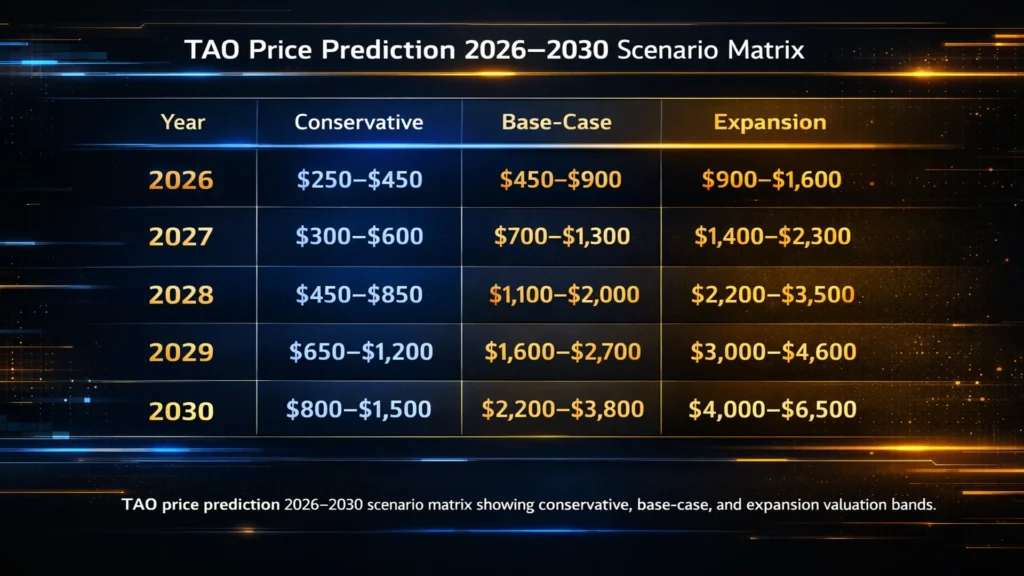
TAO price prediction 2026–2030 scenario matrix
Year | Conservative TAO price prediction | Base-case TAO price prediction | Expansion TAO price prediction
2026 | $250–$450 | $450–$900 | $900–$1,600
2027 | $300–$600 | $700–$1,300 | $1,400–$2,300
2028 | $450–$850 | $1,100–$2,000 | $2,200–$3,500
2029 | $650–$1,200 | $1,600–$2,700 | $3,000–$4,600
2030 | $800–$1,500 | $2,200–$3,800 | $4,000–$6,500
This scenario matrix summarizes the TAO framework. The rest of this article explains the math and the conditions.
TAO price prediction calculator: market cap logic
A TAO price prediction should show implied market cap logic, because market cap is what the market actually prices. TAO price is just market cap divided by circulating supply.
Formula used in this TAO price prediction:
TAO price = implied TAO market cap ÷ circulating TAO supply
Because long-horizon emissions create uncertainty in exact float, this Bittensor price prediction uses circulating supply bands by year. These are scenario tools, not exact forecasts.
Assumed circulating TAO supply bands used in this TAO price prediction:
- 2026: 8.5–9.5 million TAO
- 2027: 9.0–10.2 million TAO
- 2028: 9.6–11.0 million TAO
- 2029: 10.2–11.8 million TAO
- 2030: 10.8–12.6 million TAO
If you prefer to be conservative in your TAO framework, you should always use the higher end of the supply band.
Market cap tiers for the TAO forecast
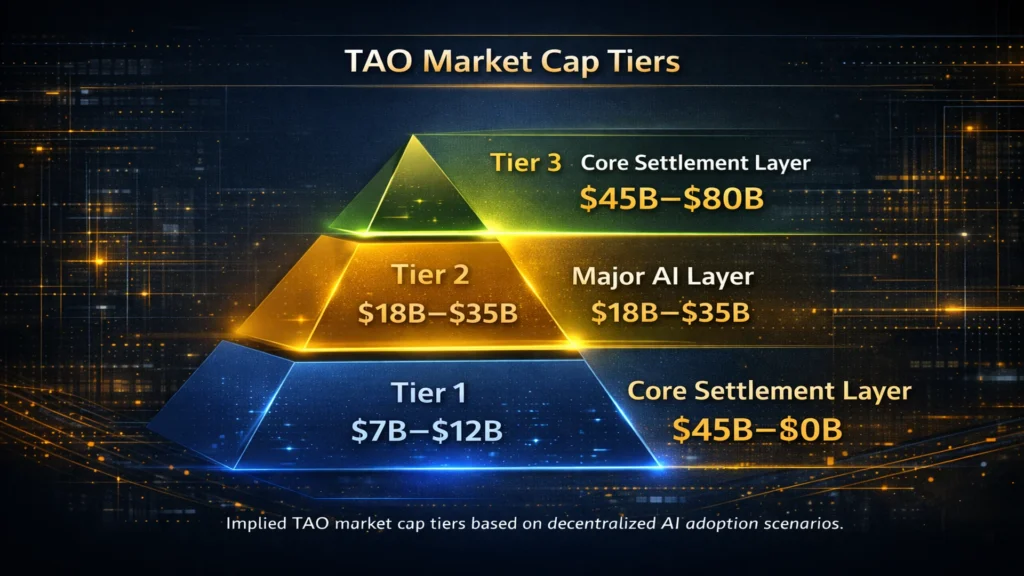
This TAO price prediction uses three market cap tiers that reflect how the market tends to price category leaders in infrastructure narratives.
Tier 1: niche decentralized AI network
Implied TAO market cap: $7B–$12B
Tier 2: major decentralized AI infrastructure layer
Implied TAO market cap: $18B–$35B
Tier 3: core decentralized AI settlement layer
Implied TAO market cap: $45B–$80B
These tiers are not “guarantees.” They are a translation layer between adoption beliefs and market pricing.
Implied TAO price ranges by market cap tier
Tier 1 ($7B–$12B) implied TAO price
2026 implied TAO price
$740–$1,410
2027 implied TAO price
$690–$1,330
2028 implied TAO price
$640–$1,250
2029 implied TAO price
$590–$1,180
2030 implied TAO price
$555–$1,110
Interpretation for this TAO price prediction: TAO remains relevant but niche.
Tier 2 ($18B–$35B) implied TAO price
2026 implied TAO price
$1,900–$4,120
2027 implied TAO price
$1,760–$3,890
2028 implied TAO price
$1,640–$3,650
2029 implied TAO price
$1,530–$3,430
2030 implied TAO price
$1,430–$3,240
Interpretation for this TAO framework: TAO is a major AI infrastructure crypto asset.
Tier 3 ($45B–$80B) implied TAO price
2026 implied TAO price
$4,740–$9,410
2027 implied TAO price
$4,410–$8,890
2028 implied TAO price
$4,090–$8,330
2029 implied TAO price
$3,810–$7,840
2030 implied TAO price
$3,570–$7,400
Interpretation for this TAO outlook: TAO becomes a core settlement layer for decentralized AI.
Mapping the calculator to the scenario bands
Now we link the calculator back to the earlier TAO price prediction bands.
Conservative scenario mapping
Mostly Tier 1 lower to Tier 1 mid. In conservative regimes, the market pays for relevance but refuses extreme premiums.
Base-case scenario mapping
Tier 1 upper plus Tier 2 lower. This is the “credible leader” regime where TAO keeps an AI infrastructure premium without becoming a mega-cap.
Expansion scenario mapping
Tier 2 mid to Tier 2 upper, with temporary Tier 3 flirtation during peak rotation waves.
Extreme upside (not included in base bands)
Tier 3. In a full leadership regime, a TAO 2030 outcome above $5,000 becomes plausible.
This mapping keeps the TAO framework internally consistent: scenario price bands align with implied market cap math.
What must be true for TAO to justify $5,000 in TAO 2030
A TAO price prediction that includes $5,000+ must show the market cap requirement. $5,000 TAO is not magic. It is market cap.
Using a rough 2030 supply assumption of 11.5 million TAO:
$5,000 implies a market cap of about $57.5B.
That puts TAO into Tier 3 territory. Therefore, TAO 2030 above $5,000 requires:
- persistent category leadership in AI infrastructure crypto
- strong subnet adoption durability
- credible incentive mechanics
- a market that is willing to price decentralized AI as a structural sector, not a passing theme
This is why the TAO framework is scenario-based: the number is conditional on sector status.
TAO vs peers: why this Bittensor price prediction assumes a leadership premium
A TAO price prediction needs comparables, not as a perfect model but as a reality check. AI infrastructure crypto includes several adjacent categories:
- decentralized compute markets
- GPU rendering and inference networks
- AI agent and data networks
TAO’s differentiation is that it tries to build a market for intelligence itself, using incentives and competition. This can justify a leadership premium if, and only if, the outputs are valuable and hard to replicate.
This Bittensor price prediction therefore assumes:
- in base-case regimes, TAO can maintain a premium multiple versus mid-tier AI tokens
- in expansion regimes, the premium can widen because markets pay extra for “category winner” positioning
- in conservative regimes, the premium compresses and TAO trades closer to peer baskets
The main risks in this TAO price prediction
A high-quality TAO price prediction must make risks explicit.
Centralized AI dominance risk
If centralized AI providers keep compounding advantages and decentralized alternatives remain niche, the TAO framework should remain Tier 1 to low Tier 2.
Incentive gaming risk
If participants can game subnets and extract rewards without producing durable value, the market will eventually discount the entire story. This risk is real for any incentive network.
Concentration and credibility risk
If rewards or influence are perceived as overly concentrated, the market may refuse to price an “open intelligence” premium.
Narrative rotation risk
Even if the thesis is correct, markets can rotate away for long periods. A TAO price prediction must assume multi-quarter drawdowns are possible.
Execution risk
Bittensor is complex. Complexity can slow adoption, even with strong incentives.
Invalidation rules for the TAO framework
This TAO price prediction includes explicit invalidation rules. If these trigger, you should reduce upside expectations and re-weight toward conservative bands.
The TAO framework is weakened if:
- subnet growth slows for multiple quarters and does not recover
- participation becomes visibly mercenary with weak retention
- credible evidence of incentive gaming becomes widespread
- ecosystem tooling and developer activity stalls
- TAO tokenomics changes in a way the market perceives as negative
A Bittensor price prediction is only as good as its ability to change when reality changes.
Practical playbook: how to use this TAO price prediction
Use this TAO price prediction like a monitoring system.
Step 1: start with the liquidity regime
If liquidity is risk-off, use conservative bands even if you love the narrative.
Step 2: track subnet quality
In a TAO framework, subnet quality is the adoption proxy. Do not confuse “many subnets” with “valuable subnets.”
Step 3: map reality to a tier
Ask yourself: is TAO acting like Tier 1, Tier 2, or Tier 3? Then use the implied TAO price ranges.
Step 4: update annually
TAO price prediction 2026 is not the same as TAO price prediction 2028. The weight shifts from narrative to durability.
Step 5: watch the market cap requirement
When people say “TAO to $5,000,” ask “what market cap is that, and what sector status is required?”
TAO price prediction 2026–2030 final outlook
This TAO price prediction concludes with a simple strategic view.
The bull case in this Bittensor price prediction is not “AI is hot.” The bull case is that decentralized AI becomes a real category and Bittensor remains the category leader. If that happens, TAO price prediction 2027 and TAO price prediction 2028 can hold premium multiples, and TAO 2030 can justify much higher market caps.
The base case in this TAO framework is that Bittensor becomes a durable niche infrastructure network with meaningful adoption, but not sector dominance. In that regime, TAO price prediction remains mostly Tier 1 upper to Tier 2 lower.
The bear case in this TAO price prediction is that incentive complexity, competition, and centralized AI dominance prevent Bittensor from becoming economically relevant at scale. In that regime, TAO price prediction is capped and volatile.
The entire purpose of this TAO price prediction is not to sell optimism. It is to give BTCUSA readers a framework that links TAO price targets to market cap logic, and links market cap logic to measurable conditions.
FAQ
What is the simplest summary of this TAO price prediction?
This TAO price prediction says TAO’s long-term upside depends on whether Bittensor becomes the category leader in decentralized AI infrastructure and whether the market prices TAO as a structural AI infrastructure crypto asset.
Is TAO price prediction 2030 above $5,000 possible?
TAO 2030 above $5,000 is possible only in a Tier 3 regime where TAO market cap approaches $50B–$80B and decentralized AI becomes a recognized structural sector.
What should I track for this TAO forecast?
Track liquidity regime, BTC dominance, subnet quality and retention, and whether TAO tokenomics and incentives remain credible.
Does this Bittensor price prediction assume constant bull markets?
No. This TAO framework is band-based because crypto moves through regimes. In risk-off regimes, the conservative TAO price prediction band matters most.
Sources
Bittensor Docs — Emissions and Token Distribution
https://docs.learnbittensor.org/learn/emissions
Bittensor Tokenomics Overview (Supply, Staking, Rewards)
https://www.cube.exchange/what-is/bittensor
21Shares Research — Inside Bittensor: Tokenomics and Emissions
https://www.21shares.com/research/inside-bittensor-the-blockchain-for-ai
Messari / Market Tokenomics Summary
https://messari.io
TAO Stats — Emission and Supply Data
https://docs.taostats.io/docs/tao
Tao Whitepaper