Revolut Integrates Solana Payments, Transfers, and Staking for 65 Million Users
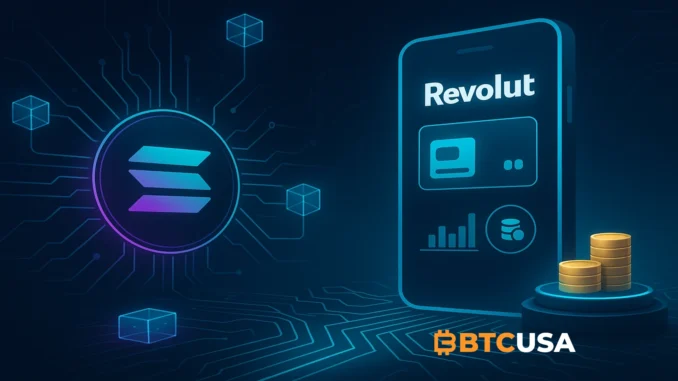
Revolut, one of Europe’s largest neobanks with more than 65 million customers and over 15 million crypto-enabled accounts, has officially added support for payments, transfers, and staking on the Solana network. The announcement marks one of the most significant institutional integrations for Solana to date, expanding the network’s accessibility to a mainstream, global user base.
This move strengthens Revolut’s crypto infrastructure and positions Solana as a core component of its growing Web3 offering.
Why Revolut’s Solana Integration Matters
Revolut is not a typical fintech: it operates as a hybrid between digital banking and a consumer crypto platform. Its decision to integrate Solana signals rising demand for high-speed, low-cost blockchain rails among conventional banking customers.
With Solana’s transaction speeds, low fees, and user-friendly infrastructure, Revolut can now offer:
• instant transfers on-chain
• staking functionality for yield-oriented users
• lower friction for cross-border payments
• an alternative to traditional payment rails
The integration also reinforces Solana’s rapid expansion across fintech applications.
Strategic Background and Recent Momentum
Solana has seen growing institutional adoption in 2024–2025, particularly in payments, mobile crypto, and consumer-facing apps. The timing of Revolut’s integration aligns with the recent announcement of Solana Mobile’s new device, SKR — a successor to Saga with expanded Web3-native capabilities.
This creates a cohesive ecosystem narrative:
• Solana Mobile expanding hardware adoption
• Revolut expanding financial-access adoption
• developers accelerating consumer-level Web3 apps
Together, these trends strengthen Solana’s position as the leading layer-1 for mainstream crypto integration
Market Impact and What Comes Next
Revolut’s support is likely to boost Solana network activity, especially among retail users unfamiliar with self-custody or traditional crypto wallets. As staking becomes available directly within a neobank interface, the barrier to earning on-chain yield is effectively removed for millions of customers.
Analysts expect a measurable uptick in:
• transactional volume through fintech rails
• staking participation
• international money movement using Solana
• demand from Web2 companies exploring crypto integration
The move positions Revolut as one of the first large-scale banks to support staking natively — a step that could influence competitors.
BTCUSA Comment
Revolut’s integration of Solana payments, transfers, and staking represents a major leap for mainstream blockchain adoption. When a neobank with 65 million users enables direct on-chain interaction, it transforms Solana from a crypto ecosystem into a global financial rail.
As traditional finance experiments with blockchain settlement and digital asset services, Solana continues to position itself as the most practical L1 for real-world usage. Revolut’s decision could accelerate the next phase of consumer crypto adoption, where on-chain payments and yield become standard banking features rather than niche tools.