Table of Contents
ZK-EVMs Enter Production-Grade Alpha
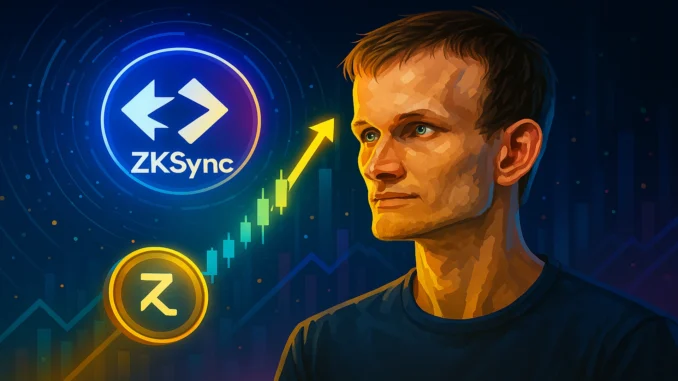
Ethereum co-founder Vitalik Buterin said that zero-knowledge EVMs are now reaching production-grade performance in alpha environments. According to him, this marks a major milestone in Ethereum’s long-term scaling strategy, as ZK-EVMs begin to operate fast enough to support real mainnet workloads.
These systems allow Ethereum blocks to be verified using cryptographic proofs instead of traditional execution, significantly reducing the cost of validation while preserving trustlessness.
PeerDAS Goes Live on Mainnet
Buterin also highlighted the recent activation of PeerDAS on the Ethereum mainnet. PeerDAS is a data-availability upgrade that enables higher bandwidth without forcing every node to download full blocks.
Together with ZK-EVMs, PeerDAS transforms Ethereum into a network that simultaneously achieves high throughput, decentralized verification, and strong consensus guarantees — a combination many believed impossible.
Breaking the Blockchain Trilemma
For years, blockchains have struggled with the so-called trilemma: scalability, decentralization, and security — pick only two.
Buterin believes Ethereum is now entering a phase where all three can coexist. With cryptographic proof-based execution and distributed data availability, the network can scale without pushing out smaller validators or centralizing infrastructure.
Higher Gas Limits and ZK-EVM Nodes From 2026
Looking ahead, Buterin expects Ethereum to start raising non-ZK-EVM gas limits as ZK-EVM performance improves. He predicts that by 2026, fully operational ZK-EVM nodes will begin to emerge, enabling validators to verify blocks almost entirely through proofs.
This shift will gradually reduce the resource burden on validators and allow a much broader set of participants to help secure the network.
ZK-EVMs as the Primary Validation Method by 2030
According to Buterin’s roadmap, the period between 2027 and 2030 will likely mark the transition where ZK-EVMs become the dominant method of block validation on Ethereum.
Instead of executing every transaction, most validators will simply verify proofs, drastically reducing hardware requirements and opening the door to deeper decentralization.
Distributed Block Building Remains a Long-Term Goal
Despite this progress, Buterin stressed that distributed block building remains unfinished. Centralized block production still creates risks related to censorship, geographic imbalance, and validator concentration.
Long-term research continues on fairer block construction mechanisms that distribute power more evenly across regions and infrastructure providers.
What This Means for Ethereum’s Future
If Buterin’s vision materializes, Ethereum will evolve into a base layer combining:
• high bandwidth from PeerDAS
• efficient validation from ZK-EVMs
• broad decentralization through lightweight node requirements
This would place Ethereum in a fundamentally different category from other blockchains struggling to scale without sacrificing trust.
BTCUSA Insight
Ethereum’s roadmap is no longer about incremental optimization — it is about architectural transformation. If ZK-EVMs truly become the primary validation engine by the end of the decade, Ethereum will be the first major blockchain to practically overcome the scalability-security-decentralization trade-off rather than merely balance it.