

Ethereum Account Abstraction Moves to the Protocol Layer
After nearly a decade of research, Ethereum account abstraction (AA) is approaching a fundamental architectural shift. Vitalik Buterin recently outlined EIP-8141 — an omnibus proposal designed to move AA from middleware-based implementations into the protocol itself.
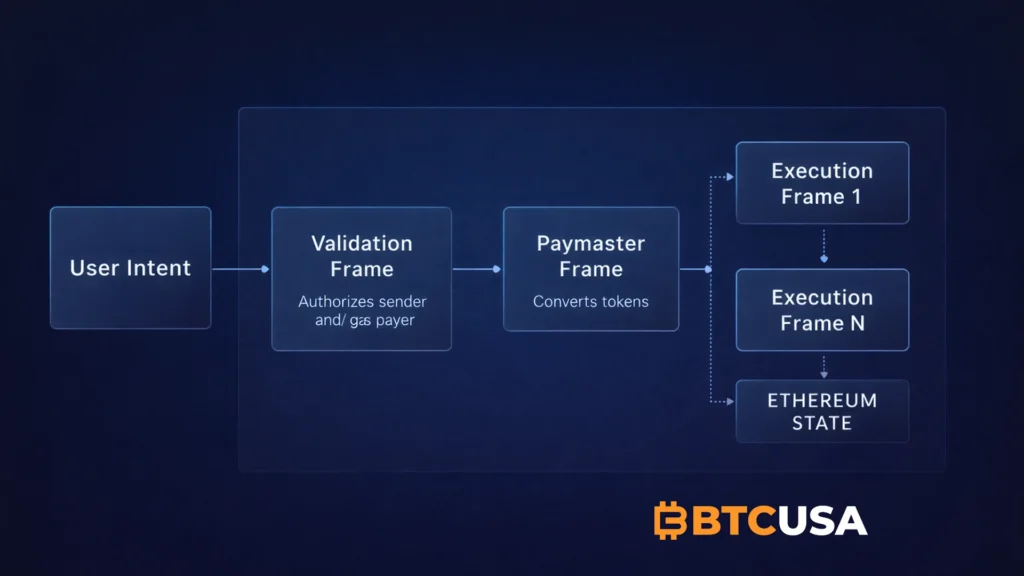
The proposal introduces “frame transactions,” a minimal yet highly general execution model that allows validation, authorization, sponsorship, deployment, and execution logic to be expressed directly inside a transaction structure.
If implemented, this would unify externally owned accounts and smart contract accounts under a single framework and remove reliance on bundlers, relayers, and intermediaries that characterize current AA deployments such as ERC-4337.
What Frame Transactions Change
In the EIP-8141 model, a transaction is no longer a single operation but a sequence of frames — discrete execution steps that can authorize the sender, authorize gas payment, deploy contracts, or execute logic.
The protocol only requires one condition:
a validation frame must return ACCEPT with gas authorization.
Everything else becomes programmable.
This structure enables:
native batching
transaction sponsorship
parallel operations
account deployment in-transaction
programmable validation logic
Account behavior moves from wallet infrastructure into protocol primitives.
Unifying EOAs and Smart Accounts
Ethereum historically maintained two account types:
externally owned accounts (EOAs)
smart contract accounts
AA research aimed to eliminate this distinction. EIP-8141 approaches that goal by allowing any account — including existing EOAs — to express custom validation and execution logic through frames.
This means:
multisig logic becomes native
quantum-resistant signatures become possible
key rotation becomes protocol-level
batch operations become standard
Wallet architecture shifts from key storage to programmable identity.
Native Paymasters and Gas Abstraction
One of the most transformative implications of EIP-8141 is protocol-level gas abstraction. Transactions can authorize separate gas payers through dedicated frames, enabling real-time token-denominated gas payment via on-chain conversion.
In practical terms, users could pay gas in:
stablecoins
application tokens
governance tokens
without intermediaries or relayers.
This collapses the distinction between transaction execution and payment routing, embedding gas markets directly into account logic.
Privacy Without Broadcasters
Current privacy systems on Ethereum rely on relayers or broadcasters to submit shielded transactions. EIP-8141 enables privacy validation frames or 2-dimensional nonce structures that allow accounts themselves to act as privacy routers.
The implication is structural:
privacy moves from network infrastructure
to account logic
This could eliminate the UX friction associated with relay dependence in privacy protocols and enable parallel private transaction reception at the account level.
Mempool and Security Considerations
While on-chain validation rules are straightforward, frame transactions introduce complexity at the mempool layer. Arbitrary validation logic could enable denial-of-service patterns or unsafe transaction propagation.
Proposed mitigations include:
conservative mempool rulesets
validation-before-execution ordering
restricted external calls in validation
staking mechanisms for paymasters
Ethereum historically separates consensus validity from mempool policy. EIP-8141 extends that philosophy, with minimal protocol rules and stricter relay rulesets initially.
Compatibility With FOCIL and Inclusion Guarantees
Account abstraction at the protocol layer aligns with other roadmap efforts such as FOCIL (Fork Choice enforced Inclusion Lists), which aims to guarantee transaction inclusion.
AA ensures complex transactions are expressible.
FOCIL ensures they are includable.
Together they move Ethereum toward a model where users can express arbitrary execution intent and receive predictable inclusion — a key requirement for advanced financial and privacy applications.
Wallet Architecture After AA
If EIP-8141 is implemented, wallets change fundamentally. Today’s wallets primarily manage keys and sign transactions. Under protocol AA, wallets become programmable policy engines.
Future wallet capabilities include:
conditional execution
policy-based spending
native batching
automatic sponsorship routing
privacy routing
multi-signature logic
The boundary between wallet and smart contract dissolves.
BTCUSA Insight
EIP-8141 represents the first credible path to full protocol-native account abstraction — a goal Ethereum has pursued since 2016. By collapsing account logic and transaction structure into a unified frame model, the proposal moves AA from middleware into consensus primitives.
If adopted, this would mark the largest shift in Ethereum account architecture since the introduction of smart contracts. Wallets would evolve from key containers into programmable identities, gas markets would become abstractable, and transaction composition would become native.
The practical impact is not incremental UX improvement but structural: Ethereum accounts become programmable agents at the protocol layer.
Sources
Vitalik Buterin on EIP-8141 — https://eips.ethereum.org/EIPS/eip-8141
Original AA proposal (EIP-86) — https://github.com/ethereum/EIPs/issues/86
ERC-4337 documentation — https://docs.erc4337.io