
The AI Stack Moves to the Edge
Tether’s latest QVAC Fabric release may look like a niche AI tooling update at first glance, but the bigger story is more structural. The company says it has launched the first cross-platform LoRA fine-tuning framework for Microsoft’s BitNet models, pushing ultra-efficient 1-bit language model customization onto consumer GPUs, laptops, and even modern smartphones. That matters because it shifts part of the AI stack away from centralized cloud infrastructure and closer to the device itself, where privacy, cost, and hardware sovereignty become the primary narrative.
For crypto-native readers, the real significance is not just that Tether is “doing AI.” It is that Tether is trying to build a local-first AI stack around the same ideological pillars that made stablecoins and peer-to-peer infrastructure attractive in the first place: control, portability, censorship resistance, and reduced dependence on centralized intermediaries. QVAC is explicitly framed by Tether as a local, private AI initiative designed to run on users’ own devices without cloud dependence, API keys, or middlemen.
What Tether actually released
According to Tether and QVAC’s Hugging Face technical write-up, the new release adds cross-platform BitNet LoRA fine-tuning and GPU inference through QVAC Fabric. The framework extends llama.cpp with Vulkan-accelerated kernels and dynamic tiling, allowing BitNet b1.58 models to run across heterogeneous hardware including AMD, Intel, NVIDIA, Apple, Adreno, and Mali-class GPUs, with support spanning Vulkan and Metal backends.
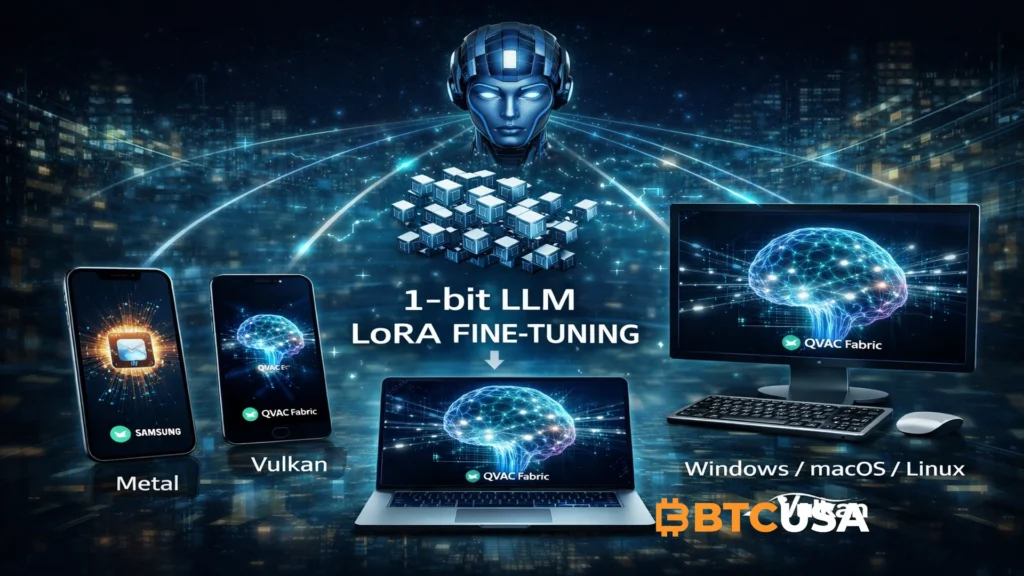
That is an important distinction. This is not a claim that users can suddenly train frontier-scale general-purpose AI models from scratch on a phone. What QVAC is demonstrating is LoRA fine-tuning, meaning the base model stays frozen while a much smaller set of trainable adapters is updated. In practice, that makes model customization dramatically lighter than full retraining and far more realistic for edge hardware.
Tether says the framework enables billion-parameter language models to be fine-tuned on consumer hardware, including smartphones. In the Hugging Face article, QVAC reports that a 125M-parameter BitNet model can be fine-tuned in roughly 10 minutes on a Samsung Galaxy S25, while a 1B model fine-tuned on around 300 documents, or about 18,000 tokens, completed in 1 hour 18 minutes on the same device and 1 hour 45 minutes on an iPhone 16. The team also says it managed to fine-tune models up to 13B parameters on an iPhone 16 under benchmark conditions.
Why BitNet matters here
QVAC’s release matters because it builds on Microsoft’s BitNet work rather than inventing a model architecture from scratch. BitNet b1.58 is Microsoft Research’s low-bit LLM design that represents weights in a ternary format and aims to preserve strong quality while sharply lowering memory, latency, and energy demands. Microsoft’s published research says the 1.58-bit design can match similar-size full-precision Transformer models on end-task performance while being significantly more efficient in memory, throughput, and energy use.
Microsoft’s official BitNet framework also states that bitnet.cpp supports fast and lossless inference for 1.58-bit models on CPU and GPU, with the project reporting substantial speedups and energy savings over conventional full-precision approaches. The official BitNet model card for BitNet b1.58 2B4T describes it as the first open-source native 1-bit LLM at the 2-billion-parameter scale, trained on 4 trillion tokens.
That gives QVAC a credible technological foundation. The Tether team is not just slapping branding onto generic quantization hype. It is extending an existing Microsoft low-bit model family into a cross-platform fine-tuning and inference pipeline aimed at everyday devices.
The real breakthrough is not “AI on phones”
AI running on phones is not new by itself. What makes this release notable is the combination of three things: cross-platform support, LoRA fine-tuning on heterogeneous edge GPUs, and BitNet’s low-bit efficiency profile. The Hugging Face post describes this as the first successful BitNet fine-tuning demonstration on mobile GPUs including Adreno, Mali, and Apple Bionic-class graphics, while also claiming inference speedups ranging from 2.1x to 11.3x on edge GPUs versus CPUs across devices such as the Samsung Galaxy S25, Google Pixel 9, and iPhone 16.
Just as important, QVAC says BitNet can fine-tune models roughly twice as large on edge devices compared with Q4 non-BitNet models, highlighting the practical memory advantage of the architecture. The post also says the Vulkan implementation preserved lossless inference behavior relative to CPU results, which matters because low-bit AI often runs into quality drift or approximation artifacts when optimized aggressively for new hardware backends.
In other words, the claim here is not only that local AI is possible, but that local AI can be customized on-device with less vendor lock-in than the conventional NVIDIA-plus-CUDA route. That could be a meaningful unlock for independent developers, privacy-sensitive enterprises, and mobile-first AI applications.
Why this matters for crypto and Tether
The strategic angle is bigger than a single framework release. Tether has been building QVAC as a broader local AI ecosystem for months. In October 2025, it launched QVAC Genesis I, a 41 billion-token synthetic STEM dataset alongside QVAC Workbench. In December 2025, it expanded that dataset to 148 billion tokens across 19 educational domains with Genesis II. Tether’s own language consistently frames QVAC as a local, decentralized intelligence effort designed to reduce reliance on centralized cloud platforms.
That positioning is highly compatible with crypto infrastructure narratives. Stablecoins made digital dollars portable across networks. Local AI tries to make intelligence portable across devices. In both cases, the value proposition is similar: reduce gatekeepers, lower switching costs, and push control back toward the user.
For Tether specifically, QVAC also broadens the company’s identity beyond USDT issuance. The firm is increasingly presenting itself as a wider infrastructure builder spanning finance, data, power, and AI. If QVAC gains traction, Tether could end up with a narrative that connects stablecoin liquidity, peer-to-peer systems, and private on-device intelligence into one larger stack.
The limitations investors should not ignore
The release is impressive, but it should not be read as proof that local 1-bit models will replace frontier cloud AI anytime soon. QVAC’s benchmarks focus on LoRA fine-tuning and inference for BitNet-family models under specific workloads and hardware setups. A phone fine-tuning a targeted 1B model on a relatively compact dataset is very different from training or serving massive general-purpose frontier models at cloud scale.
There is also a quality question that the market will keep watching. BitNet’s appeal comes from efficiency, but the long-term competitive challenge is whether ultra-low-bit architectures can sustain enough capability breadth for real-world consumer and enterprise adoption beyond narrowly optimized use cases. Microsoft’s research is encouraging, yet broad ecosystem validation still takes time.
Another practical issue is that “local-first” does not automatically mean frictionless. Developers still need usable tooling, datasets, deployment flows, and application layers people actually want. That is why Tether’s parallel push into QVAC Workbench and datasets matters almost as much as this BitNet release itself. A framework alone is not a product moat. A full edge-AI ecosystem might be.
BTCUSA Takeaway
Tether’s QVAC Fabric release is one of the more interesting AI-adjacent crypto infrastructure stories of 2026 so far because it is tied to a real technical stack, not just a token narrative. By extending Microsoft’s BitNet into a cross-platform LoRA fine-tuning and inference framework for smartphones and consumer GPUs, QVAC is pushing a more decentralized model of AI customization into the mainstream conversation.
The strongest takeaway is simple: if stablecoins decentralized the movement of money, local AI frameworks like QVAC are trying to decentralize the ownership of intelligence. Whether that becomes a durable market shift or remains an edge-device niche will depend on adoption, tooling, and model quality. But the direction is now clearer than before: the AI stack is starting to move out of the data center and back into the hands of the user.
Sources
- Hugging Face — LoRA Fine-Tuning BitNet b1.58 LLMs on Heterogeneous Edge GPUs via QVAC Fabric
- Tether — Tether’s QVAC Launches World’s First Cross-Platform BitNet LoRA Framework to Enable Billion-Parameter AI Training and Inference on Consumer GPUs and Smartphones
- Microsoft GitHub — BitNet official inference framework for 1-bit LLMs
- Microsoft Hugging Face — BitNet b1.58 2B4T model page
- arXiv — BitNet b1.58 2B4T Technical Report
- QVAC on Hugging Face — project page and prior research posts
- Hugging Face — An Edge-First Generalized LLM LoRA Fine-Tuning Framework for Heterogeneous GPUs