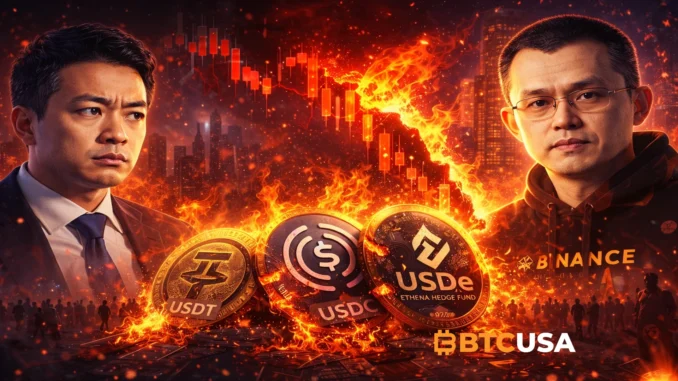

A Public Clash Between Binance And OKX Leadership Escalates
A high-profile dispute between Binance founder Changpeng Zhao and the CEO of OKX has moved into a more direct and public phase, turning what began as criticism into an open confrontation between two of the industry’s most visible exchange figures.
The latest flare-up follows renewed attention around Zhao’s recently released book, which has already brought older claims and unresolved controversies back into the spotlight. Instead of remaining a background narrative, the issue has now evolved into a real-time reputational clash between competing exchange leaders.
This broader tension is part of the same industry shift in which credibility is becoming as important as scale in crypto leadership.
The Dispute Is No Longer Just About Past Claims
At the center of the latest exchange are questions around Zhao’s personal timeline, including whether certain claims related to his divorce and earlier financial history were represented accurately in public.
The OKX CEO framed the issue not as gossip, but as a matter of truthfulness and public accountability. In that framing, the dispute moves beyond biography and into the territory of leadership credibility.
That distinction matters because crypto is increasingly operating in an environment where public trust, executive conduct, and consistency of narrative carry more weight than they did in the industry’s earlier growth phase.
CZ’s $1 Billion Bet Turns The Dispute Into A Symbolic Power Move
Zhao responded by offering a $1 billion bet, stating that he was officially divorced long before the current controversy and that lawyers could verify the matter.
He also made clear that he would not publish legal documents online, citing respect for the privacy of his former wife. That turned the exchange into something larger than a factual disagreement. The sheer size of the proposed bet made the response itself part of the message.
In practical terms, the wager is less about money than about confidence, public optics, and narrative dominance. It transforms a personal dispute into a spectacle that reinforces just how high-profile crypto leadership conflicts have become.
OKX Rejects The Bet And Reframes The Conflict Around Professional Conduct
The OKX CEO declined the offer, arguing that publicly offering a $1 billion wager is not appropriate behavior for the beneficial owner of a regulated company.
That response is strategically important because it shifts the conversation away from Zhao’s chosen framing and toward professional standards, executive responsibility, and regulator-facing optics.
In other words, one side framed the issue as a challenge of factual proof, while the other reframed it as a question of whether this is how senior leaders of major regulated crypto businesses should behave in public at all.
Crypto Competition Is Increasingly Becoming A Battle Over Narrative
The deeper significance of the dispute is not the personal detail being argued over, but what it says about the next stage of exchange competition.
Crypto firms are no longer competing only on liquidity, product breadth, or user acquisition. They are increasingly competing on public trust, brand positioning, and how their leadership is perceived in a more mature and heavily scrutinized market.
That same transition is visible across the broader industry, where a more structured crypto regulatory framework is beginning to replace enforcement-driven approaches. As that shift continues, personal credibility and public discipline will matter more, not less.
Why This Matters For The Market
This dispute may not trigger an immediate market reaction, but it does matter for how major exchanges and their founders are understood over time.
Institutional capital, regulators, and even retail users increasingly judge platforms through a wider lens than just trading volume or token listings. Leadership behavior, clarity of communication, and reputational resilience are all becoming part of the evaluation process.
At the same time, this kind of public confrontation reinforces how sensitive the broader market remains to shifts in confidence and perception, especially in an environment where global uncertainty and capital rotation are driving crypto and risk assets simultaneously.
The Real Issue Is Control Of The Story
What makes this conflict notable is that it comes at a time when Zhao is clearly trying to shape his own legacy through a more controlled public narrative.
That makes every pushback more significant. Once a founder begins presenting a definitive version of events, critics have a stronger incentive to challenge not just specific claims, but the broader story itself.
This is why the clash matters beyond the personalities involved. It reflects a market where narrative control has become part of strategic positioning.
BTCUSA Insight
This is not really a story about a bet.
It is a story about who gets to define credibility in crypto’s next phase.
The louder and more regulated the industry becomes, the less these clashes will look like random social-media drama and the more they will look like strategic contests over reputation, legitimacy, and long-term influence.
That is the real significance of a public exchange like this. The argument itself may be personal, but the implications are institutional.