
Ethereum Foundation Releases Strawmap Long-Term Roadmap
The Ethereum Foundation has published a long-term development roadmap called “Strawmap”, outlining network evolution across multiple hard forks through approximately 2029.
The document describes planned upgrades across execution speed, scaling architecture, cryptography, privacy, and data availability, with protocol updates expected roughly every six months.
Strawmap positions Ethereum’s next phase as a multi-year transformation toward faster settlement, zk-based scaling, and native privacy features embedded directly in the base layer.
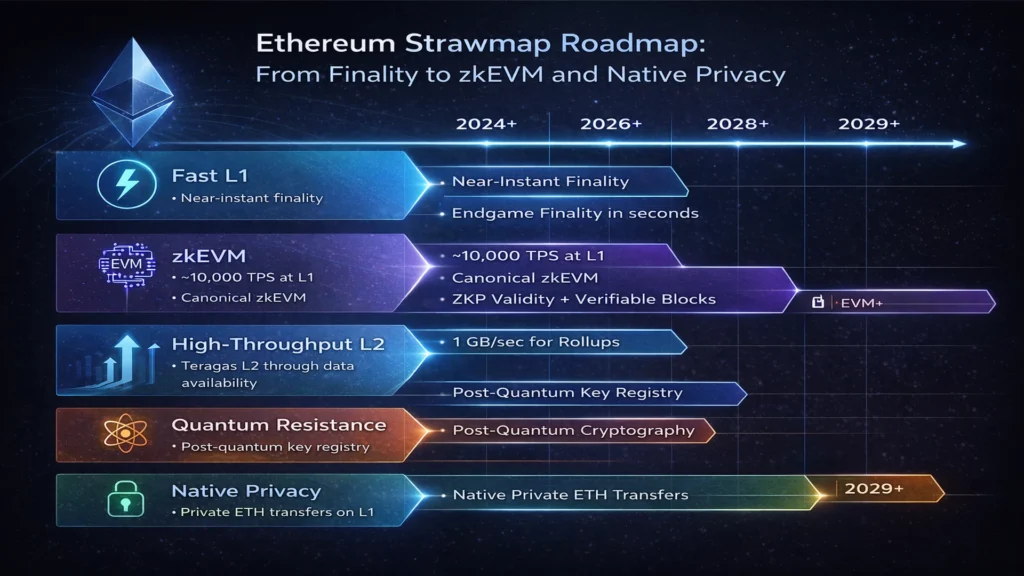
Fast L1: Toward Seconds-Level Finality
One of the roadmap’s central goals is significantly faster transaction finality at the Layer-1 level.
Ethereum currently achieves economic finality in minutes. Strawmap targets near-instant confirmation on the order of seconds, with incremental improvements beginning in upcoming forks and an “endgame finality” target around 2029.
Faster finality would improve user experience, reduce settlement risk, and support latency-sensitive applications.
zkEVM Integration: Toward Gigagas Throughput
Strawmap envisions scaling Ethereum’s base layer through integration of zero-knowledge execution proofs directly into the protocol.
The long-term goal is a “Gigagas L1,” enabling roughly 10,000 transactions per second on Layer-1 through zk-based validation and canonical zk virtual machine architecture.
By 2029, the roadmap anticipates mandatory zk-proof generation for block validity, embedding zkEVM concepts into Ethereum’s consensus and execution stack.
High-Throughput L2 via Data Availability Scaling
Layer-2 scaling remains central to Ethereum’s architecture. Strawmap targets major increases in rollup throughput by expanding data availability bandwidth.
The roadmap describes teragas-level throughput (~1 GB/sec data availability) for rollups, allowing L2 networks to scale execution while anchoring security to Ethereum L1.
This approach reinforces Ethereum’s modular scaling model: L1 for security and settlement, L2 for execution.
Quantum Resistance and Post-Quantum Cryptography
Strawmap also introduces quantum-resilience milestones.
A registry for post-quantum public keys is expected around 2026, enabling early adoption of quantum-safe cryptographic schemes. A broader transition toward quantum-resistant signatures is anticipated toward the end of the decade.
This would protect Ethereum accounts and transactions against future quantum-computing threats.
Native Privacy at the Protocol Layer
The roadmap includes native privacy features directly within Ethereum’s base layer.
The goal is to enable private ETH transfers without relying on mixers or external privacy protocols. Privacy would become a built-in capability of the network rather than an overlay.
Such functionality could allow confidential transactions while preserving verifiability and settlement guarantees.
BTCUSA Insight
Strawmap signals Ethereum’s transition from iterative upgrades to architectural convergence.
Each of the five pillars — fast finality, zk-execution, high-bandwidth data availability, quantum-safe cryptography, and native privacy — addresses a known structural limitation in current blockchain design. Together they outline Ethereum’s intended end-state: a high-throughput, low-latency, privacy-capable settlement layer secured against future cryptographic threats.
The most consequential shift is zk integration at the protocol level. If block validity becomes provable through zk execution, Ethereum’s scaling model changes fundamentally. Verification cost decouples from execution cost, enabling higher throughput without proportionally increasing node requirements.
Native privacy is similarly transformative. Today, confidentiality in Ethereum requires external protocols. Embedding privacy into the base layer would move Ethereum closer to financial-grade settlement infrastructure where transaction data can be selectively hidden without sacrificing consensus integrity.
Strawmap therefore represents more than a roadmap. It is a statement of Ethereum’s intended equilibrium architecture: zk-validated execution, rollup-centric scaling, instant finality, and privacy-optional settlement secured against quantum adversaries.
Outlook: Ethereum’s Multi-Year Architectural Shift
If Strawmap milestones are achieved, Ethereum’s base layer would evolve from a moderately scalable settlement chain into a high-throughput zk-verified platform with native confidentiality and quantum-safe security.
Key variables to monitor include:
zkEVM integration progress
finality latency reductions
data availability bandwidth growth
post-quantum cryptography adoption
native privacy implementation
The roadmap suggests Ethereum’s next decade will be defined less by incremental scaling and more by protocol-level cryptographic and architectural transformation.