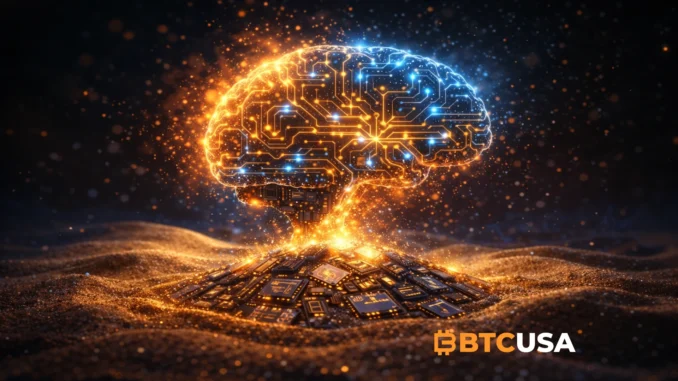

AI Arrives at the Exact Moment the World Needs It
Venture capitalist Marc Andreessen believes artificial intelligence is arriving at a uniquely critical moment in economic history.
Speaking on Lenny’s Podcast, Andreessen argued that the world has been experiencing a decades-long productivity slowdown. U.S. productivity growth has been running at roughly half the pace of the 1940–1970 period and roughly one-third of the rate seen between 1870 and 1940.
At the same time, population growth is declining across much of the developed world. Countries including China are already facing demographic contraction.
Without new productivity breakthroughs, many economies could face long-term stagnation. Andreessen’s argument is simple: AI may be arriving at exactly the moment needed to reverse that trend.
AI as the Modern Philosopher’s Stone
Andreessen describes AI using an unusual metaphor.
If the ancient philosopher’s stone was meant to turn lead into gold, AI effectively turns sand into thought.
Modern chips are built from silicon — one of the most common materials on Earth. Yet when arranged into advanced computing systems, that silicon produces something far rarer: intelligence.
In Andreessen’s view, this reframes the AI debate entirely. The biggest opportunity may not be replacing workers but dramatically increasing human productivity.
AI Widens the Gap Between Good and Exceptional
One of the clearest signals emerging from the AI transition is how strongly it amplifies top performers.
Andreessen notes that the best programmers using AI tools are not reporting small efficiency gains. Some report productivity improvements approaching 10x.
Rather than leveling the playing field, AI may widen the gap between:
• average users
• skilled professionals
• elite operators who deeply integrate AI into their workflows
In practice, this means career success may increasingly depend on how effectively individuals leverage AI tools.
The Rise of the “E-Shaped” Career
Andreessen argues that traditional career models are becoming outdated.
The idea of “T-shaped skills” — one deep specialization supported by broad knowledge — may be evolving into something different.
Instead, successful professionals increasingly combine multiple skill sets.
An individual who can:
• write code
• design products
• build narratives and strategy
may be dramatically more valuable than someone with only one of those abilities.
This multi-skill approach is sometimes described as an E-shaped career, where several complementary capabilities reinforce each other.
Jobs Will Change, Not Disappear
Andreessen also challenges the idea that AI will eliminate most jobs.
Historically, technology shifts rarely erase entire professions. Instead, they change the tasks that make up those professions.
Executives in the 1970s rarely typed their own correspondence. Secretaries handled most written communication. Email changed those workflows but did not eliminate the underlying roles.
The same pattern is likely to occur with AI. Jobs are bundles of tasks — and AI primarily changes those tasks.
AI Coding Is Just Another Abstraction Layer
Another important insight Andreessen highlights is the role of abstraction in programming.
Throughout computing history, new layers of abstraction have consistently emerged:
machine code → assembly → C → scripting languages → modern frameworks
Each new layer allowed developers to build software faster while expanding the total number of programmers.
Andreessen believes AI coding tools represent the next abstraction layer in that same progression.
AI Could Democratize Elite Education
One of the most overlooked effects of AI may occur in education.
Research known as Bloom’s Two Sigma Problem shows that one-on-one tutoring can dramatically improve student outcomes, often moving learners from average performance to the top percentile.
Historically, personalized tutoring was accessible only to the wealthy.
AI tutoring systems could potentially bring that level of individualized instruction to anyone with a smartphone.
Why AI May Not Transform Everything Overnight
Despite the enthusiasm around AI, Andreessen also acknowledges the limits imposed by real-world systems.
Many industries operate in what economists sometimes describe as “atoms” rather than “bits” — sectors such as construction, healthcare, and infrastructure.
These sectors are heavily influenced by regulation, institutional inertia, and complex physical systems.
As a result, AI’s impact may unfold unevenly across the economy.
The Biggest Unknown: Where Value Accrues
Even insiders at the forefront of AI development admit that the industry’s long-term structure remains uncertain.
Within a year of ChatGPT’s launch, multiple American and Chinese companies had produced competitive AI models. Open-source projects also closed much of the performance gap.
This raises a fundamental question: where will economic value ultimately accumulate?
Possible answers include:
• model developers
• infrastructure providers
• application builders
For now, the competitive landscape remains fluid.
Beyond Human Intelligence
Andreessen also challenges a common assumption about artificial intelligence.
Human intelligence has biological limits. IQ measurements rarely exceed around 160.
AI systems, however, are not constrained by biology. As computational power and training methods improve, machine intelligence could theoretically surpass human cognitive limits.
This possibility reframes the discussion around AI entirely. Rather than simply matching human intelligence, AI systems may eventually exceed it.
BTCUSA Insight
Andreessen’s broader framework highlights a deeper shift underway.
Artificial intelligence is not just a new technology cycle. It may represent a structural transformation in how productivity, companies, and even economic coordination function.
For the crypto industry, that transition carries particular relevance.
If autonomous AI agents begin participating directly in economic activity, they will likely require digital-native financial infrastructure — programmable payments, global settlement networks, and open monetary systems.
In that scenario, the intersection of AI and crypto could become one of the defining technological narratives of the next decade.