

Prediction Markets Keep Selling Intelligence. The Data Looks More Like Extraction.
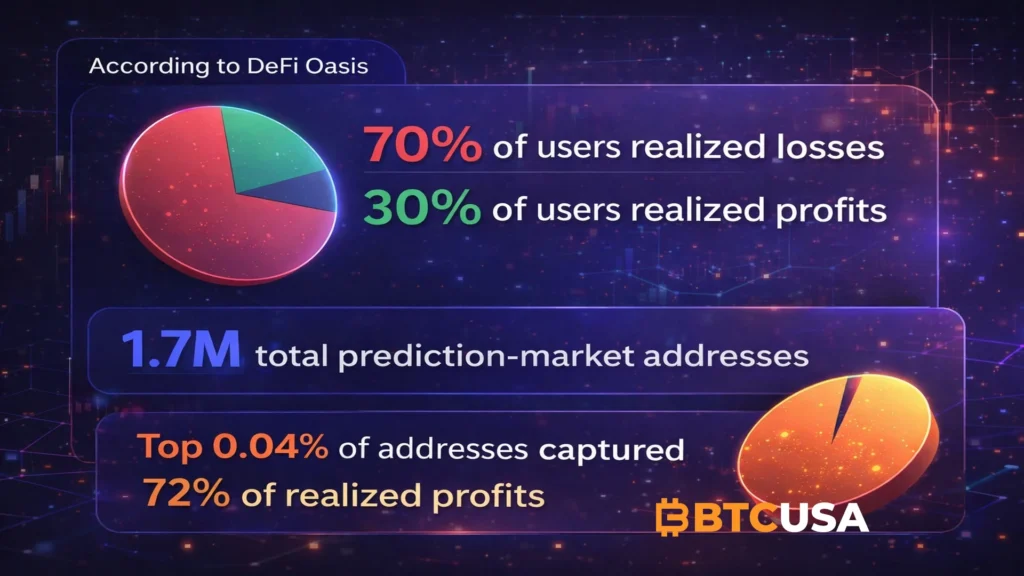
Prediction markets are often framed as truth machines: cleaner than social media, faster than polls, and smarter than pundits. But the emerging profit data paints a much harsher picture. Research attributed to DeFi Oasis and cited by multiple outlets shows that roughly 70% of Polymarket users recorded losses, while only about 30% were profitable. Even more striking, fewer than 0.04% of addresses captured more than 70% of total realized gains.
That does not mean prediction markets are useless. It does mean they may be far less democratic than the marketing suggests. A market can still generate useful signals while concentrating most of the actual money in the hands of a tiny group with better speed, sizing, execution, and information. For BTCUSA readers, that is the real story here: prediction markets may be producing prices for the crowd, while producing profits for specialists. This interpretation is based on the DeFi Oasis figures cited in public reporting.
Polymarket’s Fee Engine Is Starting to Look Serious
There is also a second number the market should be paying attention to: platform fees. DeFi Oasis said Polymarket’s daily fees reached about $927,000 on April 1, implying an annualized revenue run rate of roughly $338 million, with the possibility of $1 million-plus daily fees in the near term. That matters because it shows prediction markets are no longer just a curiosity built around internet attention. They are becoming real revenue-generating crypto businesses. And when a platform is compounding both trader losses and fee income at the same time, the category starts to look less like a public forecasting tool and more like a highly efficient extraction machine.
The Profit Distribution Is the Biggest Warning Sign
The key problem is not just that many traders lose. That is true in almost every speculative market. The bigger issue is how extreme the concentration appears to be. The Guardian, citing DeFi Oasis data, reported that fewer than 0.04% of Polymarket accounts captured a collective $3.7 billion and more than 70% of all realized profits. Finance Magnates separately cited the same DeFi Oasis analysis and said roughly 1.7 million addresses were included in the dataset.
That starts to look less like “the crowd is wise” and more like “the crowd is flow.” In practical terms, retail participation may be functioning as liquidity for a much smaller class of highly effective traders. Those traders do not necessarily need to be cheating to dominate. They may simply be better capitalized, faster to react, better at pricing ambiguity, or more disciplined about taking the other side of emotionally driven order flow. This is an inference based on the published concentration data and on how peer-to-peer markets function.
These Markets Behave More Like Trading Venues Than Betting Apps
That distinction matters. Finance Magnates, citing a Citizens JMP Securities note, said retail users on prediction markets posted worse median returns than sportsbook users over the same period: negative 8% for prediction markets versus negative 5% for sportsbooks from July 2025 to mid-March 2026. The same note said only the highest-volume traders, those with more than $500,000 in activity, posted positive median ROI.
That comparison is important because it highlights what prediction markets really are. They are not just places to express opinions on politics, sports, or geopolitics. They are trading venues with spreads, liquidity gaps, timing edges, and participant asymmetries. In that setup, being directionally right is not always enough. Execution quality matters, and execution quality tends to favor a much narrower group than the marketing around “collective intelligence” implies. This is analytical interpretation grounded in the reported return data.
Retail May Be Mistaking Access for Edge
One reason prediction markets feel attractive is that they seem more open than traditional finance. Anyone can log in, pick an outcome, and take a view. But open access is not the same thing as having an edge.
That is where the DeFi Oasis data becomes so revealing. If around 70% of users are losing and the overwhelming share of realized profits goes to a microscopic slice of participants, then the average user is not entering a neutral forecasting arena. They are entering a competitive order-matching environment where a small minority appears to understand the game much better than everyone else.
This also helps explain why prediction markets can feel “smart” even when they are economically brutal. Good prices do not require fair profit distribution. A market can aggregate information effectively while still transferring money upward toward the fastest and best-positioned traders. That tension is one of the most important things people still underestimate about this sector. This is an inference from the structure of prediction markets and the profit data reported above.
The Insider-Trading Debate Does Not Help
The concentration story becomes even more sensitive when paired with concerns around privileged information. The Guardian’s reporting on Polymarket argued that prediction markets may face an “unfairness epidemic” if users begin to believe outcomes are being priced or exploited by people with inside access or unusual influence over real-world events. The article noted that disgruntled comments often appear beneath markets with surprising outcomes, while experts warned that prediction markets can create both trust problems and distorted incentives.
That does not prove the top traders are cheating. But it does make the optics worse. When profit concentration is already extreme, even isolated episodes of suspicious timing or informational advantage can damage confidence much faster than in a more evenly distributed market. In other words, concentration magnifies legitimacy risk. This is an analytical inference based on the Guardian’s reporting and the DeFi Oasis profit distribution figures.
Why This Matters for Crypto
Prediction markets increasingly sit near the center of the onchain conversation because they combine speculation, transparency, and internet-native distribution in a way that feels very crypto. But if the underlying economics resemble an extraction engine for a tiny elite, then the category may mature into something very different from the “wisdom of crowds” ideal that helped popularize it.
For crypto, this matters because prediction markets are often treated as one of the sector’s cleaner consumer use cases. If the category becomes associated with asymmetric outcomes, professionalized extraction, and recurring fairness concerns, that could limit its credibility with mainstream users even if volumes continue to grow. This is an inference based on the published loss-rate and concentration data.
BTCUSA Insight
The DeFi Oasis numbers cut through a lot of the romance around prediction markets. These platforms may still be useful for price discovery, but usefulness is not the same thing as fairness. When 70% of users lose and a microscopic slice captures most of the money, the market starts to look less like collective intelligence and more like a highly efficient transfer mechanism.
That does not kill the category. But it does change how it should be understood. Prediction markets may not be the next great democratization of forecasting. They may be the next big venue where retail flow subsidizes sharper, faster, and more capitalized players. And if that is true, the long-term challenge is not just scale. It is legitimacy. This conclusion is an analytical synthesis of the cited reporting.