
Table of Contents
Render (RNDR) Research
AI-driven crypto asset analysis and market intelligence
Last updated: 2026-02-26
Quick Overview
Render (RNDR) is positioned as a decentralized GPU compute network most directly exposed to the AI infrastructure narrative in crypto. The asset typically behaves as a high-beta proxy for expectations around AI workload demand, GPU scarcity, and decentralized compute adoption.
The central thesis for RNDR is whether decentralized GPU markets can capture meaningful real workload share as AI usage expands, or whether the token remains primarily narrative-driven.
What Render Is
Render is a distributed GPU compute network historically associated with rendering workloads and increasingly aligned with AI compute demand. The network connects compute providers with users requiring high-performance GPU resources.
Within crypto market structure, RNDR is treated as an infrastructure token linked to compute demand cycles. This positioning makes it highly sensitive to AI sector sentiment and liquidity conditions.
Narrative Positioning
RNDR sits in the decentralized compute and AI infrastructure category.
Primary narrative vectors:
decentralized GPU compute
AI workload infrastructure
distributed rendering and training
crypto-native compute markets
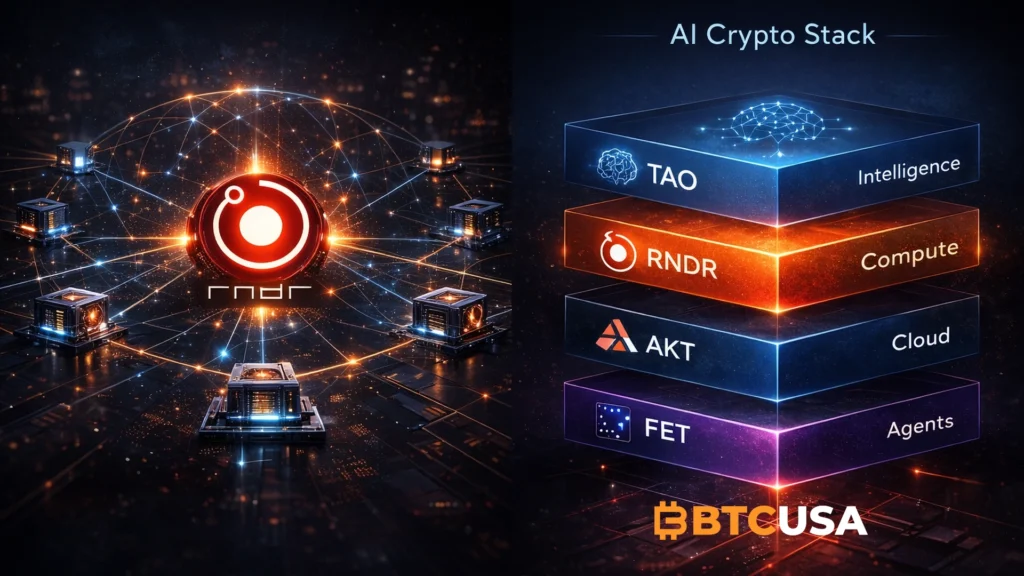
Relative positioning in AI crypto stack:
TAO → intelligence network layer
RNDR → GPU compute layer
AKT → cloud compute layer
FET → agent layer
Narrative strength: high
Narrative crowding: increasing
Narrative durability: dependent on real workload growth
Adoption Signals
The durability of the RNDR thesis depends on measurable network usage rather than narrative alignment alone.
Key signals to monitor:
network workload volume
active compute providers
client diversity
integration expansion
token usage intensity
Current adoption profile suggests early-stage but expanding experimentation, with demand still largely crypto-native rather than enterprise-scale.
Adoption stage: early growth
Token Utility and Value Flow
RNDR functions as the coordination and payment layer for compute transactions on the Render network.
Value accrual depends on:
GPU demand routed through network
provider participation growth
transaction settlement in RNDR
network fee dynamics
If token usage scales proportionally with compute demand, RNDR transitions toward infrastructure valuation. If not, price action remains narrative-dependent.
Token-utility coupling: medium
Market Behavior Profile
RNDR typically trades as a high-beta AI sector asset.
Observed characteristics:
strong appreciation during AI narrative expansions
sharp drawdowns during liquidity contraction
correlation with AI token basket
sensitivity to GPU and compute narratives
This profile supports momentum phases but increases downside risk during sector rotations.
Volatility profile: high
Key Risks
Structural risks:
AI workloads remain centralized
decentralized compute demand limited
token utility weaker than valuation
provider quality variability
Market risks:
AI narrative saturation
sector rotation
liquidity tightening
Execution risks:
slow enterprise adoption
network growth friction
competitive compute solutions
Forward Outlook Scenarios
Bull scenario
Decentralized GPU demand expands materially, integrations grow, token usage tightens, and RNDR becomes the dominant crypto AI compute infrastructure asset.
Base scenario
Steady network growth within crypto-native markets, with RNDR continuing to trade cyclically with AI sector sentiment while adoption improves gradually.
Bear scenario
AI workloads remain centralized, decentralized demand stagnates, and RNDR valuation compresses toward narrative beta levels.
Positioning in AI Crypto Sector
Within the AI infrastructure stack, RNDR occupies the compute supply layer.
Sector role: GPU compute infrastructure
Narrative rank: leading
Adoption maturity: early
Comparative beta: high
RNDR’s differentiation depends on whether decentralized GPU markets achieve sustained real usage alongside centralized providers.
BTCUSA Insight
Render is one of the clearest crypto assets aligned with the AI compute megatrend. This alignment creates strong upside during AI expansions but also exposes RNDR to volatility when narratives rotate or liquidity tightens.
The long-term investment case depends primarily on measurable workload growth and token usage intensity. Without sustained demand routed through the network, RNDR remains structurally narrative-driven rather than infrastructure-valued.
Sources
Render Network official website — https://rendernetwork.com/
Render Network overview (Messari) — https://messari.io/project/render-network
Render (RNDR) market data — https://coinmarketcap.com/currencies/render/
Update Log
2026-02-26 — Initial research publication