

Restaking Introduces a Shared Security Layer on Ethereum
Ethereum staking secures the base network through validator collateral and consensus participation. Restaking extends this security beyond Ethereum itself, allowing the same staked ETH to secure additional protocols and services.
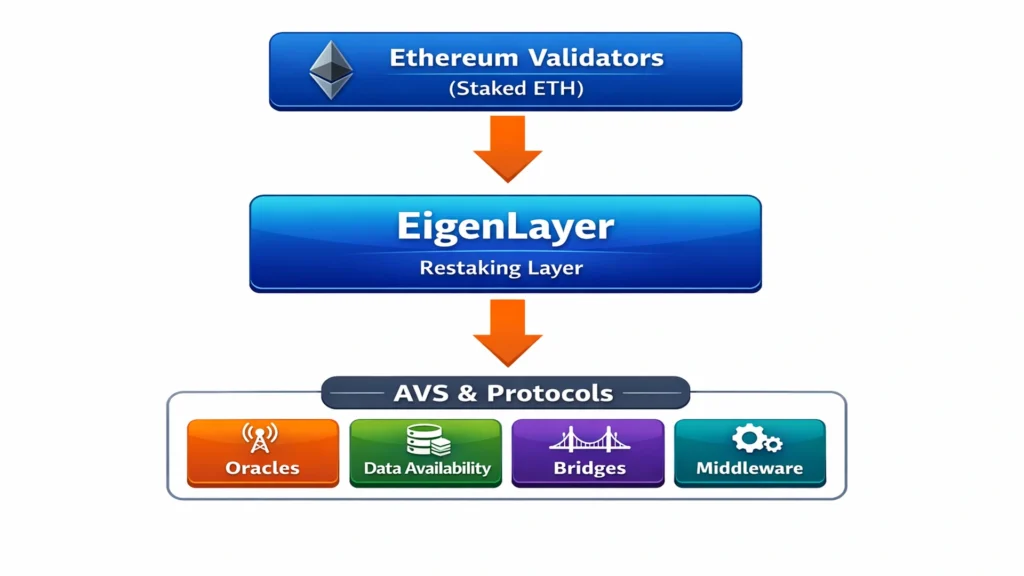
EigenLayer pioneered this model by enabling validators to opt in to securing external systems while maintaining their Ethereum stake. This creates a shared security layer where new protocols can inherit Ethereum’s validator trust without building independent validator sets.
From Single-Chain Security to Multi-Protocol Security
Traditional blockchain architecture requires each protocol or network to bootstrap its own validator set and economic security. This fragments trust and increases capital inefficiency across ecosystems.
Restaking changes this model by allowing multiple services to reuse Ethereum’s existing validator security. Protocols secured through restaked ETH include data availability layers, oracle networks, bridges and middleware services.
This effectively transforms Ethereum staking from single-chain consensus into a generalized security marketplace.
EigenLayer as a Security Coordination Hub
EigenLayer functions as a coordination layer between Ethereum validators and external protocols requiring cryptoeconomic security.
Validators choose which services to secure and accept additional slashing conditions in exchange for rewards. Protocols gain access to economic security proportional to restaked collateral without issuing native validator tokens.
This creates a two-sided market:
validators supply security
protocols demand security
EigenLayer matches both sides through opt-in restaking relationships.
Expanding Restaking Ecosystem and Use Cases
Early restaking applications focus on infrastructure services closely tied to blockchain operation:
data availability layers
oracle networks
cross-chain bridges
sequencers and middleware
These services benefit directly from strong cryptoeconomic guarantees while avoiding fragmented validator incentives.
As the ecosystem expands, restaking could extend to broader distributed services requiring trust guarantees.
Economic Implications of Shared Security
Restaking changes capital efficiency across crypto infrastructure by allowing the same ETH collateral to secure multiple systems simultaneously.
This increases yield opportunities for stakers while lowering security bootstrapping costs for new protocols. However, it also introduces correlated risk, as failures in one restaked service can propagate slashing across shared collateral.
The model therefore concentrates both security and risk within Ethereum’s staking base.
Ethereum’s Role as Global Security Layer
Restaking positions Ethereum not only as a settlement layer but also as a global cryptoeconomic security provider for external protocols.
If widely adopted, Ethereum staking could underpin security across multiple infrastructure layers including data availability, rollups, bridges and middleware networks.
This extends Ethereum’s influence from a single blockchain to a foundational trust layer across crypto systems.
BTCUSA Insight
Restaking transforms Ethereum staking into a shared security market.
By allowing ETH collateral to secure multiple protocols via EigenLayer, restaking reshapes how cryptoeconomic trust is distributed across crypto infrastructure — positioning Ethereum as a universal security layer rather than only a settlement chain.
Sources
EigenLayer documentation — https://docs.eigenlayer.xyz
Ethereum staking documentation — https://ethereum.org/en/staking/