

Table of Contents
Bittensor (TAO) Research
AI-driven crypto asset analysis and market intelligence
Last updated: 2026-02-28
Quick Overview
Bittensor (TAO) is positioned as a decentralized intelligence network designed to create open markets for machine learning models. The protocol incentivizes participants to produce and validate useful AI outputs through token-based rewards.
Within the crypto AI stack, TAO represents the intelligence layer rather than compute infrastructure. Its long-term thesis depends on whether decentralized AI coordination networks can capture meaningful relevance alongside centralized model providers.
What Bittensor Is
Bittensor is a blockchain-based network that coordinates machine learning systems through a market mechanism. Participants contribute models or validation services and receive TAO rewards based on perceived usefulness.
Unlike GPU networks that supply compute, Bittensor aims to aggregate intelligence itself — effectively creating a decentralized AI marketplace.
In crypto market structure, TAO is treated as a base AI infrastructure asset.
Narrative Positioning
TAO sits in the decentralized AI network category.
Primary narrative vectors:
open AI markets
decentralized intelligence
permissionless model networks
crypto-native AI coordination
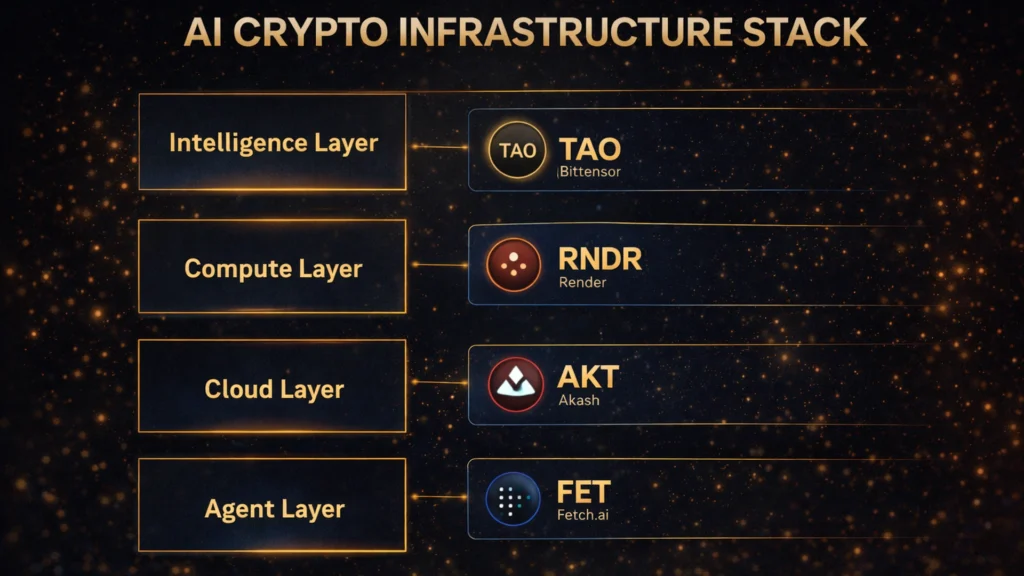
Relative positioning in AI crypto stack:
TAO → intelligence layer
RNDR → compute layer
AKT → cloud layer
FET → agent layer
Narrative strength: high
Narrative maturity: early
Narrative durability: uncertain but structurally strong
Adoption Signals
The durability of the TAO thesis depends on real AI participation rather than narrative alignment alone.
Key signals to monitor:
active subnet growth
model participation diversity
validator distribution
real workload presence
developer ecosystem
Current network activity suggests early-stage experimentation with growing technical engagement but limited external demand visibility.
Adoption stage: early
Token Utility and Value Flow
TAO functions as the incentive and coordination token of the Bittensor network.
Value accrual depends on:
model competition rewards
validation incentives
staking participation
network emission dynamics
If useful AI outputs drive subnet rewards, token demand becomes structurally tied to intelligence production. Without sustained activity, TAO remains narrative-dependent.
Token-utility coupling: medium-high
Market Behavior Profile
TAO typically trades as a high-beta decentralized AI narrative asset.
Observed characteristics:
strong rallies during AI hype cycles
sharp corrections during narrative rotations
sector-wide AI correlation
thin liquidity sensitivity
This profile creates asymmetric upside during AI expansions but high volatility outside narrative phases.
Volatility profile: high
Key Risks
Structural risks:
uncertain real AI demand
centralized AI dominance
complex architecture barrier
limited enterprise adoption
Market risks:
AI narrative saturation
sector rotation
liquidity contraction
Execution risks:
subnet quality variance
developer onboarding friction
economic incentive imbalance
Forward Outlook Scenarios
Bull scenario
Decentralized AI coordination gains relevance, subnets host meaningful workloads, and TAO becomes the base intelligence token of crypto AI infrastructure.
Base scenario
Continued experimentation and crypto-native adoption with TAO trading cyclically alongside AI sector sentiment.
Bear scenario
Centralized AI dominance persists, network usage stagnates, and TAO remains primarily narrative-driven.
Positioning in AI Crypto Sector
Within the AI infrastructure stack, TAO occupies the intelligence coordination layer.
Sector role: decentralized intelligence network
Narrative rank: leading
Adoption maturity: early
Comparative beta: very high
TAO’s differentiation depends on whether open AI markets emerge alongside centralized model providers.
BTCUSA Insight
Bittensor represents one of the most structurally ambitious AI theses in crypto — a decentralized intelligence economy rather than compute infrastructure. This positioning creates strong upside if open AI coordination becomes relevant.
However, the thesis remains adoption-sensitive. Without sustained external AI demand routed through subnets, TAO valuation will likely continue to track narrative cycles rather than infrastructure fundamentals.
Sources
Bittensor official website — https://bittensor.com
Bittensor documentation — https://docs.bittensor.com
Bittensor (TAO) profile — https://messari.io/project/bittensor