
How the Strait of Hormuz Could Reshape Bitcoin Demand
A geopolitical chokepoint may be turning into a financial experiment — and Bitcoin sits right at the center of it.
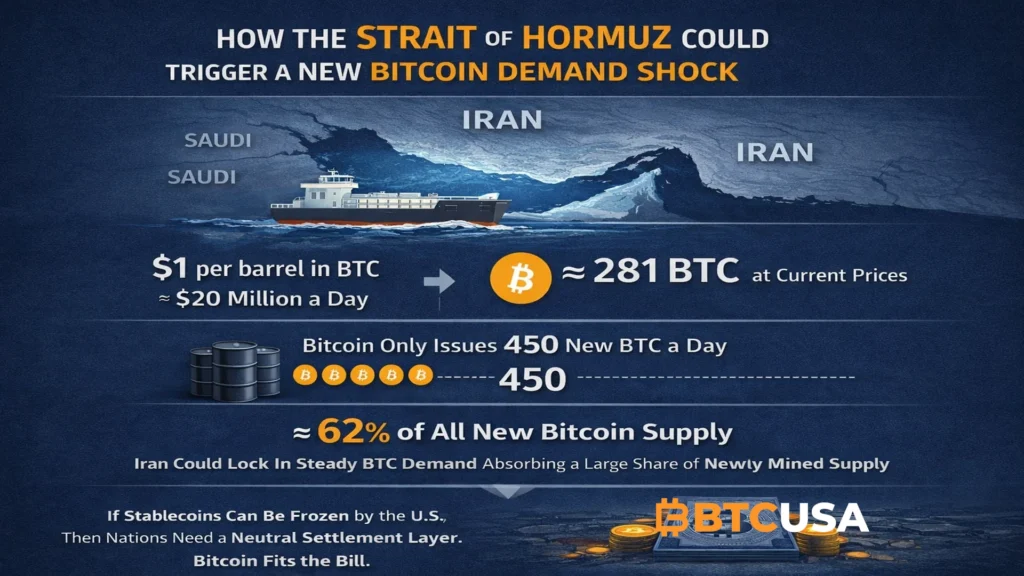
According to recent reports, Iran is exploring the idea of requiring a $1 fee per barrel of oil transported through the Strait of Hormuz, potentially payable in Bitcoin. While still theoretical, the implications of such a move would extend far beyond energy markets and directly into the structure of global crypto demand.
The scale alone is enough to shift market dynamics.
A $1 toll per barrel translates to roughly $20 million in daily flows. At current prices, that equals around 281 BTC per day — a figure that represents approximately 62% of all newly mined Bitcoin entering circulation.
With miners producing around 450 BTC every 24 hours, this would effectively absorb the majority of new supply, creating a structural imbalance between issuance and demand.
This is where macro meets market structure.
The idea that state-level actors could introduce continuous Bitcoin demand ties directly into broader discussions around Bitcoin’s role during geopolitical instability and wartime economies.
Bitcoin as a Neutral Settlement Layer
The more important shift is not the volume — it’s the mechanism.
If stablecoins and fiat rails can be restricted, frozen, or controlled at the state level, global actors are forced to look for neutral settlement alternatives. Bitcoin, by design, becomes one of the few viable options.
This dynamic is already visible in markets reacting to geopolitical tension, where capital begins rotating into crypto and gold as traditional systems face pressure, a trend explored in how macro tensions are reshaping crypto and traditional asset flows.
In that context, Bitcoin is no longer just a speculative asset — it becomes infrastructure.
Supply Shock Meets Geopolitical Demand
What makes this scenario particularly powerful is its consistency.
Unlike ETF inflows or speculative cycles, a mechanism tied to global oil transit would represent a daily, non-speculative demand flow. This kind of persistent buying pressure is fundamentally different from traditional crypto market drivers.
It also reinforces a broader shift already taking place — where Bitcoin is increasingly behaving not as digital gold, but as a macro-sensitive asset tied to liquidity, capital flows, and global risk conditions, as discussed in why Bitcoin is trading more like a growth asset than a traditional hedge.
BTCUSA Insight
If even a fraction of global commodity flows begins experimenting with Bitcoin as a settlement layer, the market is no longer driven purely by investors — it is driven by necessity.
And when demand becomes structural rather than speculative, supply is no longer just limited — it becomes insufficient.